
Nua Eléctrica: A little bit of magic for the city

By popular demand, we’ve brought the Nua Eléctrica back to our catalogue.

It’s an urban bike built around the Zehus all-in-one motor. As simple as an electric bike can be — and so, so nice to ride.
It feels like a normal bike. And that’s the point.
This bike is genuinely addictive.
Since we’ve had a test unit at our showroom, I’ve been riding it almost every day. I use it to get to and from home (even though I live just ten minutes away on foot), and I’m constantly looking for an excuse to take it out for another ride.
The secret is that it feels like riding a normal bike. Or a muscle bike, an analogue bike, or whatever other silly name they’re calling them these days.

Because of its low weight, dimensions and geometry, there’s very little to distinguish it from any other Nua urban bike. It’s pleasant to ride, stable but agile when you need to dodge an unexpected obstacle, brakes really well, and feels safe without ever becoming boring.
And then there’s the extra bit of magic: the Zehus motor in the rear wheel.

Assistance that feels natural
The Zehus system is quite remarkable in terms of how compact it is. The motor, battery and all the necessary electronics are contained inside the rear hub itself. No big battery hidden in the frame, no bulky motor around the bottom bracket. Just a very discreet hub that does a lot more than it looks like it does.
The motor pushes smoothly but with authority, always in proportion to the conditions around you.

You simply pull away from a traffic light and the bike accelerates without hesitation. But you never get the feeling that it is pushing harder than you are.
That’s what happens with many electric bikes: after two or three turns of the cranks, the bike accelerates more than you want it to, leaving you with very little control. You end up stopping pedalling and letting the bike do the work.
You see this, for example, on Barcelona’s sharing Bicing bikes. People pedal for two or three turns, stop, let inertia do the work, and then repeat the cycle.
It’s not smooth or natural pedalling. It’s more like:
Pedal to activate the motor → feel a pull that accelerates me too much → stop → repeat.
With the Nua Eléctrica, it’s exactly the opposite.
It’s always there to help you, but with respect. Never more than you want, never less.
It almost feels like it can read your mind.
The algorithm behind it has been very carefully developed. It uses several sensors, including some you don’t usually find in other systems, such as an inclination sensor.
The technology was born at an Italian university around 12 years ago, with human biomechanics and many other factors in mind that aren’t normally taken into account in typical electric-bike systems.
The result is a bike that feels like a quality non-electric bike: pleasant, enjoyable and simple, but with a little bit of magic that works in harmony with your legs and puts a smile on your face every time you ride it.
You don’t really need gears
We offer the Nua Eléctrica as a single-speed because, quite simply, you don’t really need gears when you have your friend Zehus.

Pulling away from traffic lights is easy and effortless, with a constant acceleration until you reach 25 km/h. It only takes a few seconds.
And unlike many other systems, when you reach 25 km/h the motor doesn’t suddenly cut the assistance.
If you’ve ridden an electric bike that does this, you know exactly what I mean. You reach 25, the motor cuts out, you drop below 25, it comes back on, you go above 25, it cuts out again…
The Nua Eléctrica does the opposite.
As you approach 25 km/h, the system gradually reduces the power and then maintains just enough assistance to keep you around that speed. It’s a very slight, almost imperceptible push that keeps you at the maximum speed allowed by law in a constant and very pleasant way.
And because the bike is so light and the motor doesn’t hold you back, there’s nothing stopping you from giving it some proper beans and going beyond 25 km/h using just your legs — if you’re feeling like Pogačar that day.
KERS: brake with your pedals
Another fantastic feature is the KERS system.
As well as being included in some of the riding modes (we’ll get to that later), it can also be activated directly by applying a slight backpedal.
KERS stands for Kinetic Energy Recovery System. If you’re into F1, the name will probably sound familiar.
Basically, when you apply a slight backpedal, the system activates, the bike brakes gently, and some of that energy is sent back to the battery, increasing its range.
So when you need to slow down, instead of immediately reaching for the hydraulic brakes, you can simply backpedal until you reach the desired speed.
You save your brake pads, extend your range and, once again, get to experience the simple joy of braking by backpedalling like a kid.
Fun and pragmatic. What more could you ask for?
Different riding modes — without needing your phone
KERS is also used by the different riding modes that you can activate through the simple mobile app.
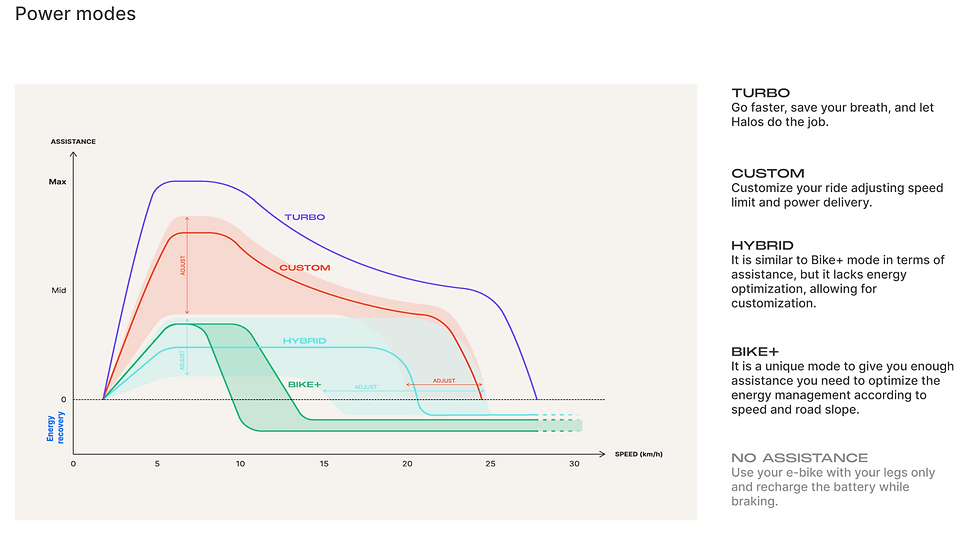
Taking advantage of the advanced sensors inside the motor, the system can do some interesting things, such as recovering more energy the steeper the descent.
There’s even a Custom mode where you can configure the parameters to your liking:

The app also shows you battery status, what you are consuming or recovering in real time, your speed, distance travelled and other useful data, without overwhelming you with information.


But here’s the important thing: you don’t actually need your phone to use the bike.
After a few days of letting the nerd inside all of us do its thing with the App, the normal thing (at least that’s what I’ve done) is to leave your preferred mode permanently activated and put the phone back in your bag.
You can ride the bike without your phone, of course. You only need it if you want to change the riding mode, configure the Custom option or check the data.
The motor itself doesn’t need the phone to work.
In fact, it doesn’t even have a power button.
The first backpedal you make activates the system. That’s it.
Zehus offers a small optional wireless remote that mounts on the handlebar, allowing you to change modes and check the battery status.

To be honest, though, I didn’t really like its functionality or the feel of the buttons. And since it isn’t necessary, we don’t offer it as standard.
Anti-theft protection
There’s another interesting feature: the anti-theft lock.
When activated, the motor will completely lock if someone tries to ride away with the bike.
Pretty useful, right?

Human+: ride without ever plugging it in
And I’ve saved one of the most interesting features of this wonderful system for last: Human+ mode.
It’s basically a mode where, under the right conditions, you can ride without ever plugging the battery into a charger.
Ever.
Sounds pretty impressive. And also a little bit against the laws of thermodynamics.
The trick is that in this mode, the motor behaves very differently from the other modes.
It recovers energy when you brake, on descents and… on flat ground when you go above a certain speed.
It’s subtle, but the system takes a little bit of energy from you in those situations. All that accumulated energy is then used to give you a small push when pulling away from a traffic light or when you hit a climb.
In short, it takes energy when you have more than you need and gives it back when you need it.
The aim is to keep the battery charge level more or less constant.
There is, of course, a catch. Human+ isn’t designed to give you the same continuous level of assistance as the normal riding modes. It’s much more about managing energy than consuming it.
So you won’t get the same powerful push you get in Turbo mode. Instead, you get small amounts of assistance at the moments when they are most useful, while the system tries to recover enough energy to keep the battery going.
And that’s what makes it so interesting.
Personally, I think that in everyday use, if you already have plenty of charge in the battery, you probably won’t use it much — unless you think the charge you have won’t be enough to complete your ride.
In that situation, it makes a lot of sense.
You can be sure you’ll always have that little bit of assistance when starting from a standstill or tackling that final climb before getting home, even if the bike doesn’t help you — or even slightly slows you down — for the rest of the ride.
And what if you run out of battery?
In any case, running out of battery on the Nua Eléctrica isn’t a big deal either.
At barely 12 kg in its lightest configuration, and with the clutch inside the motor, it handles just like a non-electric bike.

And then there’s the question everyone asks about an electric bike: range.
This is always difficult to give a precise answer to because, as you know, it depends on many factors: how hilly the terrain is (steep climbs use a lot of battery), how often you stop and start, rider weight, tyre pressure, etc., etc.
From my experience, in Turbo mode, with maximum power and consumption, riding around Barcelona and with my 78 kg body weight, getting 40 km of range is pretty easy.
Barcelona is quite flat in the direction parallel to the sea, although there are some climbs when you ride perpendicular to the coast.
In other modes, I’d expect to get 50 km or more.
Barcelona is around 8 or 9 km long, so you can cross it several times before running out of battery.
For standard commuting in a medium-sized city, charging it every three or four days is usually enough.
We think that’s more than enough.

The bike itself is still a Nua
We’ve talked enough about the electric side of things.
The rest of the bike is, as with any other Nua Bike, configurable through our Bike Builder, which you’ll find on our website on the Nua Eléctrica model page. We’ll leave the link here to make things easy.
You can configure it with a carbon fork and other black aluminium components for a sportier look — and to save some weight.


Or you can go for all titanium (fork, stem, handlebar, seatpost, etc) for some serious bling and elegance that will turn heads out there.

Your choice.
You can also add our integrated SON lighting system with a dynamo hub.
The hub generates its own energy whenever the bike is moving, making the lighting system completely independent from the motor battery.
So if the battery runs out, the lights keep working.
We think this is particularly important from a safety point of view, and it’s also something that distinguishes our bikes from many others.
Built for one person, not for a shelf
Like all Nua Bikes, the Nua Eléctrica is built using high-quality materials and components chosen for their durability, low maintenance and long-term performance.
The titanium frame, Gates belt drive and carefully selected top-quality components are there for a reason: we want this to be a bike you can ride for many, many years without worrying about it.
Titanium doesn’t rust, the belt doesn’t need lubrication, and there are no unnecessary parts or complicated systems to maintain.
All Nua Bikes are made to order.
That means we don’t have bikes sitting in stock, not even frames. Every frame and every bike is made to order and tailored to its owner.
It’s a product made by and for one specific person, with all the care and time necessary to make it as good as possible and to last as long as possible, with as little maintenance as possible.
I hate planned obsolescence, and I firmly believe that it’s better to buy fewer things, but the best quality you can afford.
With the Nua Eléctrica, you’re going to spend more money when you buy it. But if you look at the cost per kilometre over its lifetime, it becomes a much more economical product.
And it maximises enjoyment while minimising worries, which is also something worth considering.
Getting to work, or wherever you’re going, after actually enjoying the journey has quite a lot of value.
And being able to enjoy it even when it’s standing still…
Come on.

You can’t tell me it isn’t beautiful.
Discover the Nua Eléctrica and explore all its features.
Ready for your dream bike? Configure your Nua Eléctrica here


Comments